Eileen M. Collins
Class of 2026
- Colonel USAF (Ret.)
- Former Space Shuttle Commander NASA
- Author and Speaker
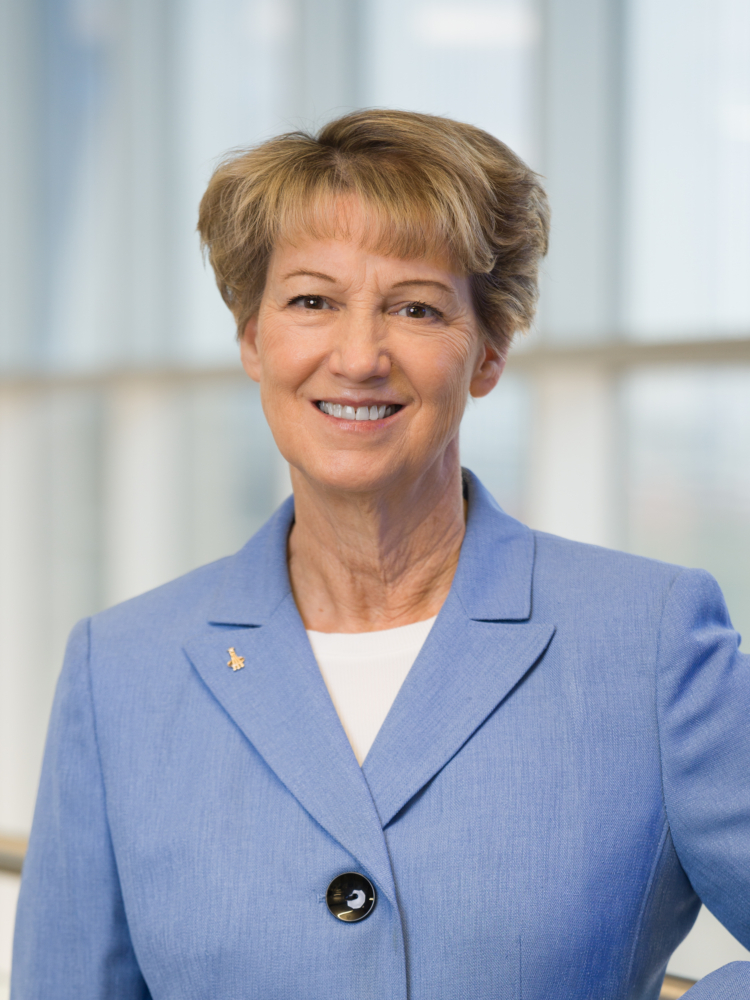
Reach for the stars—whatever your stars may be.
Eileen Collins, the second of four children, was born in 1956, in the town of Elmira in upstate New York. If not for certain circumstances, she might have lived her whole life there, possibly as a math teacher. But her father’s acute alcoholism and her own passion for exploration pushed her in a different direction. “My father had good and bad traits and both sides of him shaped me,” Collins says. “He was intimidating, loud, and opinionated. He was tough, but fair, and knew right from wrong. He abhorred indecisiveness and laziness.”
Collins’ father served during World War II and worked in his family-owned pub upon his return. When he married, he left the pub and became a surveyor for the city. During Collins’ childhood, her father’s alcoholism was out of control. When she was nine, her parents separated. “My father’s drinking included DUIs, jail time, and stays in hospital and rehab. It was debilitating to the point that he could not work. We moved from a two-bedroom house into subsidized housing when I was seven. We were on and off welfare and food stamps.”
After her parents separated, Collins never lived with her father again; however, her parents remained married and her father continued in a parental role whenever he was sober. Her mother took a job as a stenographer at the Elmira Correctional Facility. To better understand her father, Collins eventually became familiar with the 12-step program of Alcoholics Anonymous (AA). “My father improved,” she says. “He made friends at AA and became a speaker. He helped many other people recover, but he suffered relapses for the remainder of his life.”
Collins was the only person she knew whose mother worked, and her family’s situation made her feel inferior and disgraced. In the second grade, she took speech therapy to aid her severe stutter. The impediment made her shy and afraid to speak up, but internally she was an extrovert and enjoyed being with people. Eventually, she was able to overcome her stutter.
By the fourth grade, in 1965, space had captured her imagination. She read all she could about flying and space and dreamed of being an astronaut, even though there were no female astronauts at the time. Her back-up plan if she was unable to make her dream come true was to marry an astronaut.
Collins enjoyed school, especially her math and science classes. But when she joined her school’s home economics club to be with her friends, her father told her: “Don’t follow the crowd! Think for yourself!” Her mother’s advice: “There is no one in the world exactly like you. We are put on this planet to fulfill a need somewhere in the world.”
In 1972, Elmira was flooded with the remnants of Hurricane Agnes. Forced to evacuate from their home, their first place out of subsidized housing, they returned to find it inches deep in mud and debris. They had to throw out half of their belongings. Two years later, Collins’ mother—overcome with her life’s challenges—had a complete mental breakdown. She was hospitalized for a month, but her full recovery took years.
Collins became the acting head of the household and took care of her mother and her younger siblings, along with the cooking and cleaning chores. “I began to see that living passively and making bad decisions was ruining lives,” Collins says. “I vowed to never let that happen to me, but I felt I had to leave Elmira to escape my fear and uncertainty. The structured life of the military seemed to be what I desperately needed.”
To stay near her mother, Collins achieved her AA from Corning Community College. At that point, she felt her mother was recovered enough that she could go to Syracuse University, where she earned a BA in math and economics. She went on to achieve masters’ degrees from Stanford and Webster University. During her junior year in college, she joined the Air Force Reserve Officer Training Corps. She went on active duty at the age of 21, and was in the first class of women to go through pilot training at her base, Vance Air Force Base (AFB) in Enid, Oklahoma. “There were four women out of about 500 pilots on the base and we were in a test program to see if women could fly military aircraft,” Collins says. “This program went on for about three years, and—obviously—we proved women can fly as well as men.”
The military was a good fit for Collins, who liked the precision and exactness of flying. She also believed in her missions. “In the military, there is organization and you always know what is expected of you. The structure and stability of that suited me.”
After graduating from the Air Force Undergraduate Pilot Training program and becoming the first woman to earn pilot’s wings at Vance AFB, Collins remained at Vance as a T-38 instructor pilot, and later became a C-141 aircraft commander and instructor pilot at Travis AFB. From 1986 to 1989, she served as assistant professor of mathematics and a T-41 instructor pilot at the U.S. Air Force Academy in Colorado. Now a captain, she finally felt it was time to put her lifelong dream into motion and applied to be an astronaut.
“I went into my astronaut interview with the idea that this opportunity would be good practice, never thinking I would be accepted in my first attempt,” Collins says. “I have degrees in mathematics and operations research—where we solve large problems by defining variables and writing constraints, computer programs, algorithms, and models. There were no current astronauts with those skills. Regardless, it was a huge honor to be chosen as the first woman pilot of a space shuttle.”
Eileen Collins built one of the most groundbreaking careers in NASA history, becoming a trailblazer for women in spaceflight. She was the first woman to pilot a U.S. space shuttle and later the first woman to command one. Over four missions—STS63, STS84, STS93, and STS114—she logged more than 36 days in space, playing key roles in ShuttleMir operations, deploying the Chandra Xray Observatory, and leading the shuttle program’s return to flight after the Columbia tragedy. Her career is widely recognized not only for its technical achievements but also for its symbolic impact, inspiring generations of future astronauts and expanding the possibilities for women in aerospace.
Collins retired from the U.S. Air Force in 2005 with the rank of colonel. The following year, she left NASA to spend more time with her family and pursue other interests. In 2013, she was inducted into the U.S. Astronaut Hall of Fame. Other honors include her induction into the National Women’s Hall of Fame in 1995 and the National Aviation Hall of Fame in 2009. She is the recipient of the Distinguished Flying Cross and the NASA Outstanding Leadership Medal. The Encyclopedia Britannica named her as one of 300 women who have changed the world.
“My career came with a huge sense of responsibility,” Collins says. “As the first woman to pilot and later command shuttles, I was aware I was setting a precedent for other women to follow. I dealt with that by making sure I was mission-focused. I studied, I took extra simulators, and I asked a lot of questions. In the end, I knew I couldn’t waste time feeling unsure of myself. I knew I was prepared for these positions and other people depended on me for their lives.”
When addressing young people, Collins is quick to point out the blessings of living in the United States. “In America,” she says, “you can be anything you want to be. This country was built on freedom, which is what makes us unique and creative. Freedom lets us make choices, but it also allows us to take risks and make mistakes. All the successful people I know have made mistakes, but they used those experiences to build and change and try again.”
Honored and grateful for her Horatio Alger Award, Collins says, “I have always been a mission-oriented person and I am anxious to support the mission of the Horatio Alger Association. I am passionate to inspire young people, especially those interested in STEM, to aim high and believe in their own potential. I want them to reach for the stars—whatever their stars may be.”
When Collins was on her last space flight, knowing she was going to retire soon, she felt much like Dorothy in the Wizard of Oz. “I was reflecting on my career and all the speed bumps I have had to traverse to make my dreams come true. I did it. I accomplished every goal, I traveled over the rainbow, but in that moment, I reached a paradox: On the last day of my last mission, all I wanted was to go home to be with my family. Today, I devote myself to serving my family, my community, and my country by helping to inspire the leaders of tomorrow.”