Douglas S. Witcher
Class of 2026
- Founder and CEO Smart Choice
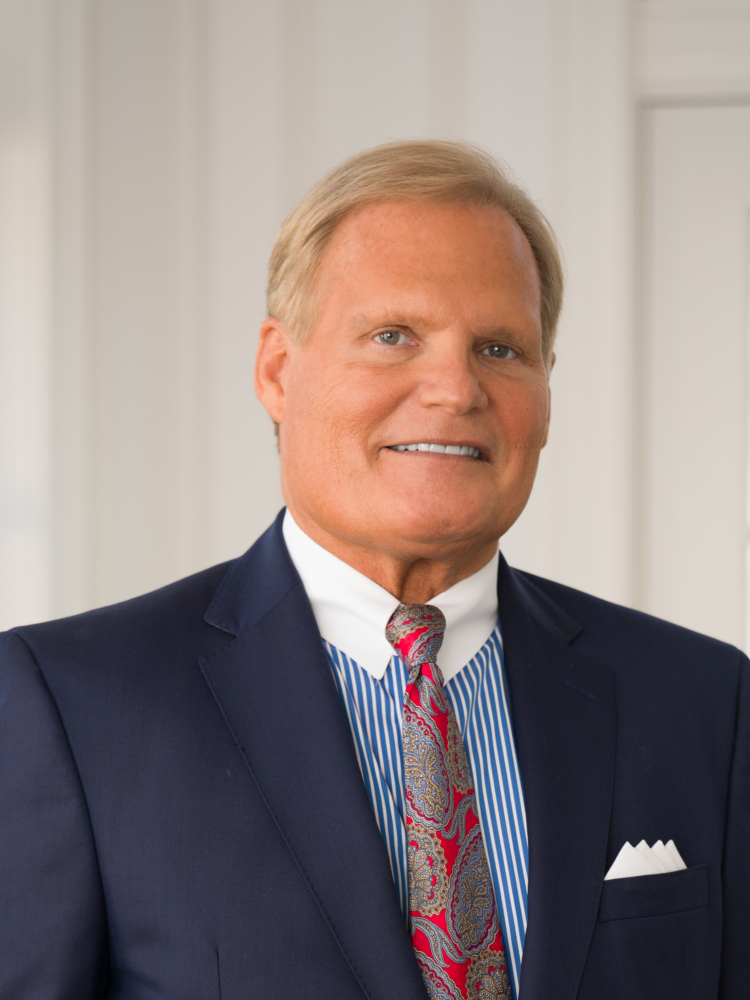
In this country, we are all guaranteed an opportunity to succeed.
Douglas Witcher was born in 1954 in High Point, North Carolina. “I was very fortunate in my family,” Witcher says. “We were surrounded by our relatives on both sides, and our church played a central role in our lives. We didn’t have much financially, but my mother used to tell me that love was our currency.”
Witcher’s father had a landscaping business, and his mother was the secretary at the local elementary school. When Witcher began his school years, it was expected that he would do as well as his older brother, who was considered a brilliant student. “From the beginning, school was a struggle for me,” Witcher says. “I was sociable and athletic, but when it came to reading and spelling, I failed repeatedly. In the fourth grade, we were given an IQ test, and my score was as high as the smartest boy in my class. After that, I was labeled lazy. I couldn’t figure it out. I was trying, I just wasn’t succeeding.”
In high school, Witcher was all-conference in football. As he got close to graduation, some people suggested he become a policeman or a fireman, but Witcher wanted to go to college. His guidance counselor encouraged him to pursue his dream. Following his high school graduation in 1972, Witcher attended Western Carolina University.
“I think I made straight Ds at Western,” Witcher says. “I dropped out and returned to High Point to work for my father’s landscaping company. At the same time, I enrolled at the community college.”
Witcher repeated his freshman year courses, and with tutoring from two teachers from his high school, his grades improved. He decided it was time to return to college. This time he enrolled at High Point University.
Dr. Nido Qubein, a Member of the Horatio Alger Association since 2006, is the president of High Point University. “Dr. Qubein has a strategic communication style that makes people feel both inspired and challenged to elevate their own expectations,” Witcher says. “He became my mentor and eventually my friend, and High Point University became the turning point of my life. It was transformational for me. I became a leader and served as president of my fraternity and a dorm director. High Point taught me how to be an adult.”
One of Witcher’s professors noticed his struggles with reading, and suggested he write down the text of his course book in a spiral notebook. Amazingly, this exercise had a dramatic effect on Witcher’s comprehension. Although his professor meant he should copy only one book, by the time Witcher graduated, he had hand copied 50 textbooks. Later in life, while serving on the school board for children with learning differences, Witcher learned about dyslexia. “I asked one of the teachers to test me, and sure enough I’m dyslexic. It explained all my difficulties with reading. Just having the diagnosis was a huge relief for me.”
Witcher graduated in 1977 with a degree in education. His plan was to become a teacher, but while working as a student teacher, he took a real estate course and got his broker’s license. Believing he could make more money in real estate than teaching, he became a full-time sales agent. When mortgage rates reached near 18 percent, making home ownership out of reach for millions, Witcher switched careers once again and became an insurance agent.
In 1979, Witcher established Douglas S. Witcher Associates in a small storefront office in High Point. In the beginning, he did what thousands of small insurance agencies did every day: He knocked on doors, built relationships, and tried to get access to the carriers his clients needed. But the longer he worked inside that system, the more he realized how uneven the playing field really was. Big agencies had all the leverage.
Witcher felt that squeeze personally. He watched promising accounts slip away because he couldn’t get into certain carriers. He saw talented agents struggle not because they lacked skill, but because they lacked access. He began to wonder: Why should every small agency have to fight this battle alone?
Witcher began imagining a structure that was not yet in existence—a way for independent agents to band together without giving up their independence. If he could create a network that pooled their collective strength, he could negotiate carrier relationships on their behalf. He could give them the kind of access he had spent years chasing. He could turn the disadvantages of being small into the advantages of being part of something bigger.
In 1994, he took the leap. What began as Douglas S. Witcher Associates evolved into something far more ambitious: Smart Choice, a program built on the simple idea that independent agents deserved the same opportunities as the giants. It started regionally, almost experimentally, but the model resonated instantly. Agents who had been shut out suddenly had doors opening. Carriers who once overlooked small agencies now saw a unified, scalable distribution channel.
As Smart Choice grew, Witcher’s role shifted from running an agency to running a movement. The company expanded across states, then across the country, eventually becoming one of the largest agency networks in the United States. In the end, Smart Choice was born from a working agent who got tired of hearing “no,” and decided to build a system where the answer could finally be “yes.” Today, Smart Choice is the country’s fourth-largest insurance network with 11,000 independent agencies and 250 partners.
Witcher recalls, “When I was growing up, I spent a lot of time with my maternal and paternal grandparents, who both had farms. One of my grandfathers couldn’t read, but he was often asked to lead a prayer in church. When he stood to speak, it became so quiet you could hear a pin drop. Everyone admired him, as did I. My grandparents taught me the importance of honesty and transparency and hard work. They were generous to their neighbors and community. I wanted to grow up to be like them, and I think that their qualities that I have always tried to emulate have served me well personally and in business.”
Grateful to be an American, Witcher says, “In this country we are all guaranteed an opportunity to succeed. I think that to take advantage of that opportunity, you need to be willing to learn and develop the ability to trust others. My advice for the Scholars is to have determination and to believe in whatever it is they are working towards. They should take their dream and wrap it around themselves.”
For Witcher, his dream was being a college graduate. Due to his learning disability, most of the people around him didn’t believe he could accomplish that goal. “I learned a trick along the way,” he says. “I decided that I was going to take this challenge and find something positive about it. When I found a way to overcome my dyslexia, I had a huge appetite for knowledge. I have applied that same ‘trick’ to my business life. In all my challenging situations, I have looked for the positive, looked for the lesson to be learned.”
When Witcher was a student at High Point, one of his on-campus jobs was running the periodicals department. He helped students find sources for term papers, taught them to use the card index system, and retrieved journals and magazines for them. He often ended his shift around midnight. “I would walk across campus to my dorm, and I would think about the great opportunity I had been given to attend this college. I had a huge appreciation for what it was doing for me personally. It was expanding me. It was giving me confidence. I hope that all students develop an appreciation for the opportunity their school is trying to give them.”
The Douglas S. Witcher Family Foundation has given generously to his beloved alma mater, High Point University, which has resulted in two major facilities being named for him: the Witcher Athletic Center and the Douglas S. Witcher School of Humanities and Behavioral Sciences. “This school shaped my personal and professional trajectory,” he says. “I have a strong desire to invest in future generations.”
Witcher continues, “That’s what I love about becoming a part of the Horatio Alger Association. In addition to the scholarship, the members offer mentorship. The brain trust of this organization is massive. It’s unlike anything else in the country. I have had wonderful mentors in my life, and I’m hoping I can become an active mentor to the Scholars.”